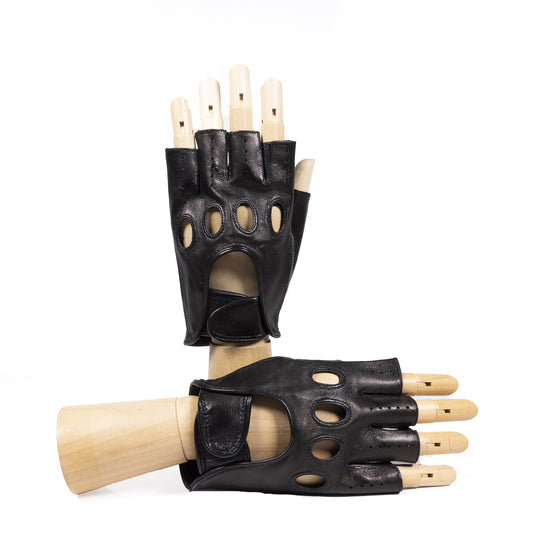
A conscious buying guide: how to recognize genuine Italian artisanal craftsmanship
Distinguishing a handcrafted leather glove made according to traditional Italian methods from a mass-produced industrial item is not just a matter of aesthetics, but of longevity, comfort, and fit.
While mass production seeks maximum economic yield through standardized processes, Italian artisanal glove-making works in harmony with the natural properties of the raw hide. Here are the 4 key elements to evaluate before making a purchase:

1. Hand-cutting and leather yield (the stretch test)
Industrial products: Leather is mechanically cut using press dies to optimize production time. The result can be rigid or unpredictable elasticity, causing the glove to pinch the fingers or lose its shape.
Artisanal craftsmanship: The Italian master glove-maker performs manual table-cutting, measuring and stretching the dampened hide by hand to harness its natural longitudinal and width stretch.
How to recognize it by touch: The leather should give gently in width, molding around the hand like a second skin, while maintaining its length and the slender silhouette of the fingers.
2. Suppleness, grain, and natural markings
Industrial products: Corrected-grain, split, or heavily coated leathers are often used to conceal imperfections, resulting in a stiff, plasticized feel.
Artisanal craftsmanship: Fine full-grain lambskin or sheepskin is drum-dyed to achieve rich, lasting color while preserving the leather’s natural character.
How to recognize it by touch: Genuine glove leather feels remarkably supple and warm, with the distinct scent of fine-tanned leather. Subtle pores and natural grain variations are not defects, but signs of authentic leather.

3. Flexibility and tactile sensitivity
Industrial products: They can feel bulky and stiff around the joints, limiting everyday movements.
Artisanal craftsmanship: A fine glove offers exceptional tactile dexterity, thanks to leather thickness calibrated with precision by the master craftsman.
The test to try: Clench your hand into a fist. A mass-produced glove may resist and form rigid folds across the knuckles; a fine handmade glove should yield effortlessly without binding or adding bulk.
4. Stitching and internal craftsmanship (lining)
Fourchette construction: The fourchette, the narrow leather strip between the fingers, is essential for three-dimensionality and freedom of movement. In industrial gloves, it may be cut straight and quickly; an artisan hand-shapes and pares each fourchette for an anatomical fit.
The inner lining: Fine handcrafted gloves use natural linings such as cashmere, silk, or virgin wool, hand-tacked at the fingertips for breathability and thermal insulation.

The Gala Gloves commitment to excellence
For Gala Gloves, excellence begins long before the cutting table: with the selection of the raw hide.
Not every hide is suitable for a luxury glove. Gala Gloves rigorously grades each leather from the wet-blue stage, when the chrome-tanned hide is first evaluated in its purest form.
Experts assess each hide by hand and eye according to two fundamental criteria:

Structural integrity: Only flawless full-grain hides with a uniform, elastic, and durable grain structure are selected.
Color affinity: The hide’s natural porosity and grain structure determine how it will react to dyeing. Master dyers select the ideal leather for each shade, achieving deep, vibrant, and uniform colors without masking the natural texture with synthetic coatings.
It is this meticulous approach, from the selection of the raw chrome leather to the final hand stitch, that transforms a simple winter accessory into a true piece of Italian high tailoring.