




Frequently Asked Questions
What is carpincho leather?
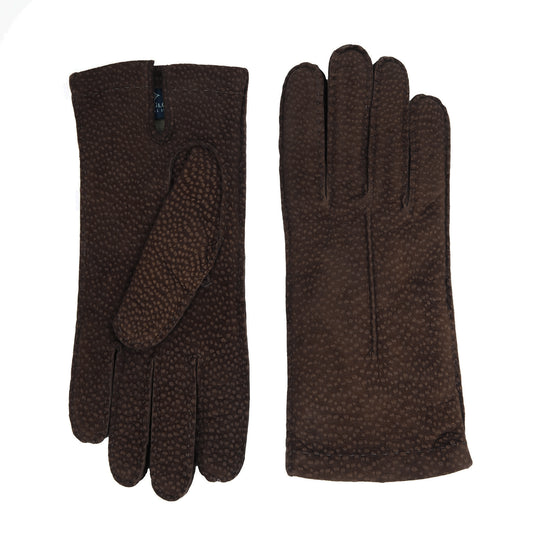
Carpincho is the South American capybara, the world's largest rodent. Its hide produces leather marked by visible round pores arranged in clusters of three, soft to the touch and notably water-resistant. Hunted under regulated quotas, supplied in small lots.
Why are the pores in groups of three?
Capybara hair grows in tight clusters of three follicles. When the hide is tanned and finished, the empty follicle marks remain as the visible round pores. The pattern is unmistakable and verifies authenticity.
Is carpincho suitable for everyday wear?
Yes, and it is also naturally water-repellent. Resistance and softness make it suitable for both occasion wear and more frequent use.
Where does carpincho come from?
From regulated hunts in Argentina, Paraguay and parts of Brazil, according to local quotas.
How do I care for carpincho gloves?
Carpincho is naturally water-repellent, more so than nappa, so light rain is manageable. Avoid prolonged soaking. Blot dry with a soft cloth if wet, air-dry at room temperature, condition lightly with leather cream once a season.
What size should I order?
Measure the circumference of your dominant hand at the knuckles. View the women's size guide for the full method. Carpincho softens but doesn't stretch significantly; pick your true size.
WOMEN’S GLOVE SIZE GUIDE
Size guide
Women's gloves
Finding your perfect fit is easy. Follow these two simple steps to measure your hand:
- Measurement A (Hand Length): Measure from the base of your palm to the tip of your middle finger.
- Measurement B (Palm Circumference): Wrap a soft tape measure around your hand at the level of your knuckles (excluding the thumb).

Size chart
| International Size | Glove Size | A in cm (Hand Length) | B in cm (Palm Circumference) |
|---|---|---|---|
| XS | 6.5 | 15 – 15.5 | 17 |
| S | 7 | 16 – 16.5 | 18.5 |
| M | 7.5 | 17 – 17.5 | 20 |
| L | 8 | 18 – 18.5 | 21.5 |
| XL | 8.5 | 19 – 19.5 | 23 |
- Leather gloves mold to your hand over time — initial snugness is normal and desirable.
- Need help? Contact us via Live Chat or email — we'll help you pick the right size!

